NWTC's program pages are the top entry point on the website for prospective students, driving 613K views and 278K sessions annually, yet the content was written and structured primarily as an academic planning tool rather than an enrollment driver. Pages were written at a college sophomore reading level, organized around an idealized full-time course sequence that few students actually follow, and largely invisible to the search terms prospective students use. A conversion rate of 4.6% from program page visits to Request for Information form clicks signaled a significant missed opportunity.
The retirement of CatCertPub, the legacy system used to enter, approve, and publish program information, created a rare opening. Its replacement, CourseDog, supports configurable approval workflows, making it possible to formally route program content through Marketing review for the first time. This project is building the strategy, governance model, and content workflow to take that opportunity.

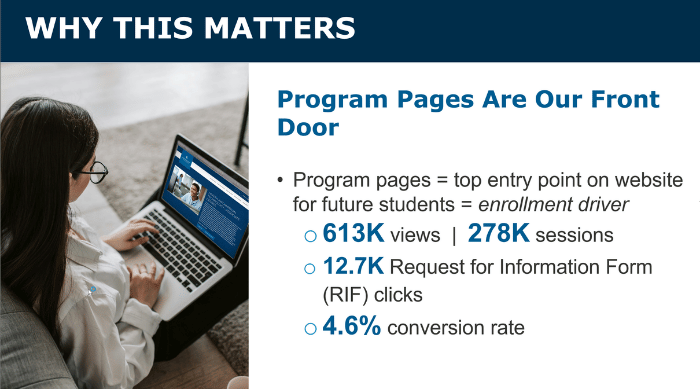
Program pages were accurate but not persuasive. Academic staff entered content through a system designed for state approval submissions, which shaped how information was framed. Program requirements and course sequences took precedence over the student questions the page actually needed to answer: Can I do this? Why should I choose NWTC?
Four specific problems emerged from an audit of existing pages and search performance data:
Students searching for NWTC programs couldn't reliably find them. Program keywords ranked at an average position of 36.88, the fourth page of search results, with a keyword click-through rate of 0.9%.
Content was written above the reading level of many of the students NWTC serves, making pages harder to understand, harder to translate, and harder to act on for first-generation students and adult learners returning to school.
Pages lacked differentiators. Competing colleges offered similar programs, but NWTC pages gave prospective students no clear reason to choose NWTC over the alternatives.
The course list presented only one path through a program, a full-time, no-transfer-credit, idealized sequence, which made programs feel less accessible than they actually are and obscured the flexibility that is one of NWTC's genuine competitive advantages.
I identified the opportunity created by the CatCertPub retirement and developed the case for Marketing's involvement in the new CourseDog workflow. I built and presented the proposal to Academic Leadership, framing program pages as enrollment tools rather than academic records and making the case for a collaborative content review process between Marketing and Academic Affairs.
Following leadership adoption of the proposal into NWTC's strategic enrollment management plan, I shifted into the implementation phase. I collaborated with IIT's Enterprise Systems Analyst and the Curriculum Modification team to map where content should live, distinguishing fields best managed in CourseDog from content more appropriately maintained in the CMS by teams already working there regularly. I met with the Marketing team to design a prioritization and workflow strategy for managing the content backlog before the CourseDog implementation goes live in March 2027.
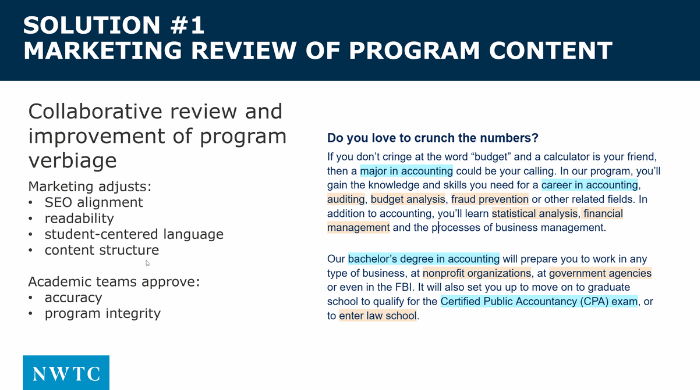
Because program content touches multiple teams with genuinely different relationships to CourseDog, the first priority was mapping each team's workflow before designing the governance model. Academic Affairs enters and approves content, Curriculum Modification manages the annual shell creation process, Marketing reviews for SEO and readability, and Enrollment maintains related content in the CMS.
This surfaced a key decision: not all content belongs in CourseDog. Enrollment logs into the CMS regularly and maintains their content there more effectively than they could in a system that would require new training. Recognizing that kept the workflow design focused and avoided scope creep that could have stalled adoption.
For the content backlog, the team developed a prioritization approach: work through existing Associate Degree programs first, then Technical Diplomas and Certificates, using the months before the March 2027 CourseDog launch to get ahead of the volume. When the new system goes live, the focus can shift to programs that are new or have major changes, rather than being overwhelmed by the full catalog at once.
The project is establishing a formal Marketing review step within the CourseDog workflow, the first time Marketing has had a defined role in how program content is written before it reaches the public website. The workflow routes content from Academic Affairs through Marketing for SEO alignment, readability editing, and differentiator development, then back to Academic teams for accuracy review and approval before publication.
In parallel, the content strategy addresses each of the four problems identified in discovery: keyword alignment to improve search visibility, readability targets of grade 7 to 9, a structured process for collecting and surfacing three differentiating factors per program, and a shift in how the course list is presented. Rather than a prescriptive semester-by-session sequence, the new approach reflects how students actually move through programs.
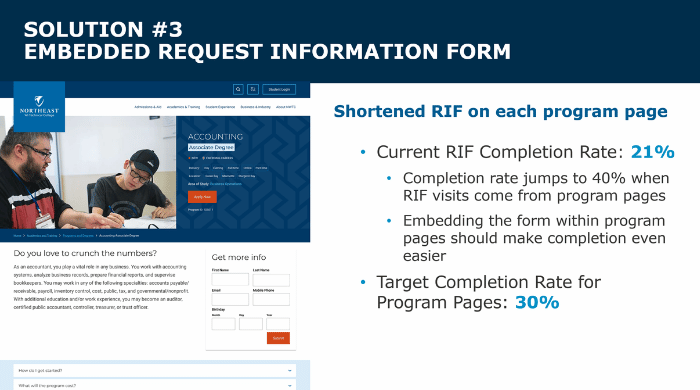
An embedded Request for Information form on each program page is also part of the solution, designed to capture prospective student interest at the moment of highest intent rather than requiring a separate navigation step to a standalone form.
CourseDog implementation is scheduled for March 2027. Current work focuses on backlog content review, workflow configuration planning, and building the internal processes that will allow the new workflow to scale across the full program catalog.

